“English is my worst subject.”  True or False?

Whenever I tell people I’m an English teacher, they say “Uh oh… English was my worst subject in school.” Now what did they mean by this? These are people who are native speakers of English! So how could English have been their worst subject in school?

I put this, “Why was English your worst subject?”, into the search bar. One person said he didn’t like English because he was always asked to write his opinion of things and then told that he was wrong.

Have you ever had this experience?

In writing, we must present our ideas in a clear and orderly fashion. We must take ideas and support them with facts or real-life experience.  Sometimes when students write essays, we teachers are not telling our students that their opinions are wrong, but that they have not properly supported and developed their ideas.  At the same time,  much attention in writing classes is paid to the question: Is this a fact or an opinion? Some people confuse a fact with an opinion, but this can be remedied with proper training.

So if you are an ESL student or a native English speaker, in fact no matter what language you write in, your writing should reflect a logical flow of ideas that the readers can follow.   Learning to write clearly in this manner can be a really beautiful experience that can open up a whole new world to the writer.

Today I opened my AOL mail account and this example of bad grammar went off in my ears like a car backfiring. We hear it so often that people barely understand that it is entirely grammatically incorrect.

What’s wrong with the ubiquitous “You’ve got mail“?  This phrase is used in my own AOL account and shared by the blockbuster movie of the same name (which features this email relationship).

Even the most grammatically correct of us say “You’ve got to see this” but this is admittedly BAD GRAMMAR.

Let’s look at this verb by verb, beginning with the verb “(to) have“.

  • The simple present tense of this verb would be “You have mail. (Come pick it up.)”
  • The present perfect tense of this verb would be “You’ve gotten mail. (Why haven’t you opened it?)”

Let’s look at the verb “(to) get“.

  • The simple present tense of this verb would be “You get mail (every day except Sundays).”
  • The simple past tense would be “You got mail (yesterday).”
  • The present perfect tense would be “You have gotten mail* (every day for the last 2 months. Why haven’t I?”  * or “You’ve gotten mail…”)

So there is no such correct verb form for “You’ve Got Mail” at all! And yet we hear this composite of verb forms  everywhere.

A word of advice: Avoid saying it! Instead of “You’ve Got Mail”, say You Have Mail.” And instead of saying “You’ve got to hear this,” say “You have to hear this.

And if you are going to use it occasionally in conversation, be aware that it is not correct English and be able to use correct grammar when socially necessary. Speaking with bad grammar might mean you don’t get the job you are looking for, and more.  And certainly never use it in writing. Unless, of course, you want to write copy for advertisements.

Stay tuned for a future podcast, where we discuss the advertising slogan, “Got Milk?” and why that too is grammatically incorrect.

You wanted an easy answer, didn’t you!  Sorry, I can’t give it to you!  You’re learning English!

Let’s say you are learning a new word.  A new noun.  The reasonable thing to assume that it is a regular noun, and that it is a countable noun and has a plural form.  As a rule, the plural form of a noun is constructed by adding an ~s or ~es to the singular form.

In most cases, that would work. But that’s where you may get into Grammar Trouble-ville.

So let’s do some research.  Let’s  look up a new word in a dictionary.

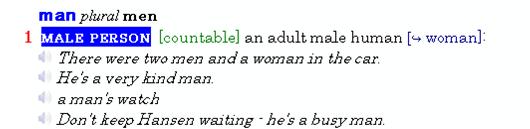
I looked up the word “man“  in my beloved little Webster’s Dictionary that I’ve had since I was a child.  It indicated man. n.; pl. MEN .  I next turned to my Longman Dictionary of American English that I’ve just taken off of the shelf for this purpose.  Right after the main word “man” was a note indicating its part of speech:  “n“  (for noun) and then “men”. So we’re good in both dictionaries, right from the beginning.  We learn the plural form for the noun man is men.

Now I tried this on an online Longman Dictionary of Contemporary English .  Go ahead; click on “man 1 noun”.

Right here it says “man plural men“. That’s it! This is a countable noun that has an irregular plural form.

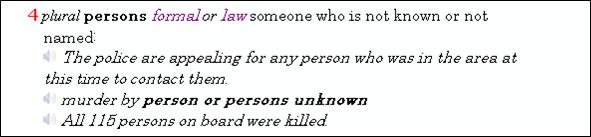
I next tried the common (singular) noun “person“.  My little Webster’s Dictionary didn’t say anything about its plural form (“people”).  Might this mean that the plural of person is persons?  My Longman Dictionary of American English (very helpful for learners of English) had, after all the definitions, at the very end of the entry, a “USAGE” note:  “The usual plural of person is people.”  You see, there is a plural form of person: persons, but its meaning is not our standard one:  We would not say “I saw many persons in the park.”  The form persons tends to be legalistic and mathematical.

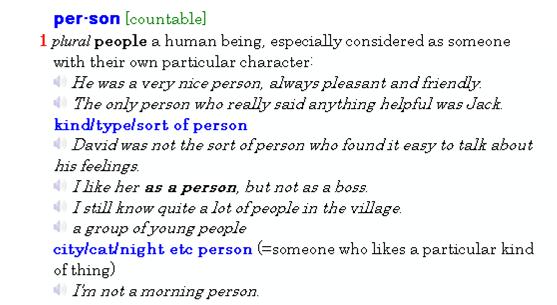
I tried Longman’s  online dictionary
This tells us “person [countable].  Now it gives us the first “1” common definition:  MALE PERSON [countable}. So now we know we can say “There were many people looking for work.”

Let’s scroll down a little further, to definition #4:


“4
plural persons” And we see this has a different meaning and use, as I wrote above, a more formal use.

So let’s practice and look up the word “woman“:  We find woman n women. That tells us the singular is woman, the word is a noun, and the plural is women.

As a rule, the plural form of a noun is constructed by adding an ~s or ~es to the singular form.

How about working this backwards !

Let’s look up “women“. In a hard copy dictionary, we see nothing there!  Dictionaries will not list the plural form of a word in its listings. So if this occurs to you, then you will have to figure out what its singular form is.  Either put on your thinking cap, or consult a grammar book.

Or look online: and there it is!

Now suppose you look up the word “change” – referring to the coins such as quarters, dimes, nickles and pennies.  The next question here is – how do you even know IF a word has a plural form? We have many words in English that do not have a plural form! Nouns such as these are referred to in a number of ways: non-count nouns, non-countable nouns, uncountable nounsWhatever you call then, you will need to know if the noun even has a plural form.

Stay tuned for our next blog post: How to Know if a Noun is Countable or Noncountable!

Click on the “play” button.

Wait a minute for the video to upload. Then relax.  Here we are, sitting by the bank of the Charles River, upriver from Boston.

Can you relax?

What do you observe? What is happening?

Write your thoughts below. In most cases, you will be using the present continuous (also known as present progressive) verb tense.

Hello!

Here is an excellent question received from a viewer.  Because we did not have your email address, we could not respond to you personally via email. However, there’s a bright side to that because we will answer your question on the blog for all to see!

The question was:  “Shouldn’t it me 24:7 and not 24/7?” The question is about how we write this expression, “twenty-four (24) seven (7)”.

First, let’s review what this representation represents, for those who don’t know: It refers to twenty-four hours a day, seven days a week. We can also say twenty-four hours per day, seven days per week.

The expression 24/7 is the way we write “twenty-four seven”. The forward slash / is commonly used to indicate “per”. Thus, we abbreviate “twenty-four (24) hours per day, seven (7) days per week” as “24/7″.

To us, 24:7 is a ratio or a division problem: 24 divided by 7.

I hope this helps!

Thanks for your question.

The ESL Help Desk!

It’s really nice to know that people want to know how to begin a letter. First, it’s nice to know that in this world of telephones, there is a real interest in writing!  It’s also great to know that our readers want to be polite, socially acceptable, and grammatically correct!

Here’s a request I received from a reader recently:

Please tell me about some phrase begging of the letter Like ( I hope find you in the best of health or I hope find well ect…

My question back is – to whom would you be writing? To a friend?  To a business associate?  To a relative or parent?  This will help me come up with some beginnings based on the social relationship.  There are more formal and less formal ways to ask this question.

Let’s look at the two openings you suggested:

I hope this letter finds you well” is a very polite opening, and one that indicates good manners.  It also would be sent to somebody whom you already know.  Your variant would be “I hope this letter finds you in the best of health.“  Of course, as I indicated, this is a polite opening, and written to somebody whom you already know, so you want to use it appropriately.  You also want to use this with someone who will appreciate the fine language.

If you want to write a letter to somebody you do not know, let me know and we can broaden the conversation and come up with some other appropriate openings.

Thank you for your question; it is a very good one!

*******

We received this question from a reader:

How would you end a letter sent to the IRS. It is staight to the point but yet thaks them for their time and attention to this matter.

Platiro in Colorado

Our response was the following:

Dear Platiro In Colorado,

Thank you for your question.

I would say that you are on the right track; just follow your instincts in this case.

In one sentence, you would thank the reader for his time and attention to this matter. On another line, you would follow that up with an appropriate salutation, and on another line conclude with your name.

I hope that helps.

Sometimes a question that seems simple on the surface hides many other issues going on beneath the surface.  Here is another question that we have received from a reader:

Dear Help Desk,

Does a closing of an e-mail to a friend with “All the best” always mean a farewell?

With kind regards,

(name withheld)

We responded:

(name withheld),

Thank you for your question.

It is becoming a common way of ending an email between friends, and even people who do not know each other. Where it is not appropriate to end with “love”, “All the best” is appropriate because it is a congenial salutation.

Have you received this ending lately? If so, on what type of email?

The ESL Help! Desk

Next, we received the following question in return:

Dear Help Desk,

Thank you very much for the prompt response. The matter is that I have a friend. We had been known each other personally (not intimately) for half-a-year before becoming distant correspondents during the next six months. However I cannot assume we both know much about each oher. I recently sent an email with “All the best” ending and have not received a timely reply. I was just thinking if this could be concidered by him as my will to end our virtual relationship.

My kind regards,

(name withheld)

To which we responded:

(name withheld),

Hmmm…I don’t think that the time lag between your hearing from this pen pal and the present time can be attributed to your ending an email with “all the best”. However, how long has it generally been between emails?
Could your pen pal be on a vacation or traveling due to work? Or perhaps there has been, God forbid, a family tragedy? Sometimes people’s email goes down, as well.

If your relationship had been intimate, then I would say that “All the best” is not appropriate; it will establish distance. However, as you describe it, such was not the case. Could it be that this pen pal did desire a more intimate relationship? Of course you would want to be careful about that in any case, given the problem of these internet relationships.

Before you switched to “All the best”, how did you and he typically end your emails? I would suggest that you either 1) wait and see if and when you receive a response; or 2) send another short note and just say that you are  hoping everything is well with him, and sign it, “Your friend, (name withheld).”

But if you are going to use choice “b”, then wait a bit, as some people are weary of others being “pushy”.

Wishing you all the best!

the ESL Help! Desk

Do you write every day? Do you write in English every day?  A great way to improve your English is to write a little bit in English every day. A writer knows that he has to write every day – and it’s not always easy.  It’s the same thing for a person who wants to learn a new language. You have to write a little every day, even if your writing contains a mistake or two.  Even if what you write contains just one line or one sentence, such as “It’s a beautiful day today”, you will be helping yourself to better English.  Making a comment on a blog is another good way to write.

Some people want others to correct them when they make a mistake.  Others don’t like to be corrected. Do you like to be corrected? If not, why not? How do you feel when you are corrected? Do you feel embarrassed or do you welcome the correction as the way to better English?

If you want to be corrected, you may have to ask people to please correct you because they may be uncomfortable doing it. They may think that you do not want to be corrected!  Letting them know that you do will resolve that misunderstanding and everybody will be happier and better off in the end.

After a person has corrected you, do you repeat the correct sentence aloud?  Repeating the correct word or phrase or sentence will help you in the future.

© 2012 ESL HELP! Desk: Help for Learners of English Suffusion WordPress theme by Sayontan Sinha

© 2009-2012 ESL HELP! Desk All Rights Reserved -- Copyright notice by Blog Copyright