

A Lot of Nothing: How to Quantify a Noun
Podcasts for Learners of English

 Today
is Tuesday, February 27th, and this is the ESL Help
Desk inviting you to listen to today's podcast.
Our website provides grammar lessons, audio stories
and more. All of our examples and audio stories
are authentic language generated by other learners
of English. We're glad you have visited
us today and to all of our listening audience
Today
is Tuesday, February 27th, and this is the ESL Help
Desk inviting you to listen to today's podcast.
Our website provides grammar lessons, audio stories
and more. All of our examples and audio stories
are authentic language generated by other learners
of English. We're glad you have visited
us today and to all of our listening audience
A Lot of Nothing
How to Quantify a Noun
Quantifying Countable and Noncountable Nouns
Today we are going to continue to discuss countable and noncountable nouns, a topic which we began last week. In this lesson, we are going to talk and learn about quantifying countable and noncountable nouns.
To read the previous lesson and one which will provide
background to today's lesson,
read
"One,
Two, Three Little Countable Nouns".
The Problem
I recently received the sentence below from a learner of English. The meaning of the statement is clear, but there are some problems with grammar. Here is the sentence:
-
I went to Back Bay station yesterday to buy train
tickets, but there is no parking space.
Noun Quantifiers
The problem in the sentence concerns the use of count and noncount nouns and the use of noun quantifiers. There are several ways to write this sentence correctly.
How would you correct the above sentence? Type your idea into the IDEA BOX below.
The Foundation
Quantifiers are words
that indicate how much of something there is. There
are quantifiers for plural countable nouns
and for noncountable nouns (which only
exist in the singular form).
The quantifier exists in the
noun determiner position, that is,
right before the noun.
Plural Countable Nouns: Examples of quantifiers for plural countable nouns are:
few ~ , a few ~ , fewer ~ , a couple
of ~ , a lot (of) lots of ~ , a ~ number of ~ , many
~
too many ~ , no ~ , not enough ~ , enough ~ , a half
(of) ~ , all (of), etc.
a lot of grammar lessons
many grammar lessons
Noncountable Nouns: Examples of quantifiers for (singular) noncountable nouns are:
-
little, a little, a lot (of), a great deal of, much, too much, all (of), no, not enough, enough, half (of), less, more, etc.
a lot of grammar
much grammar
We can also use quantifying a plural countable noun, We can also use these quantifiers in combination:
I'd like to have a lot less grammar homework.
Below is a picture of garbage. The word garbage is a noncount noun.
 How
would you describe what you see, using a quantifier?
Write a sentence in the textbox below.
How
would you describe what you see, using a quantifier?
Write a sentence in the textbox below.
The correct sentence is -
I see a lot of garbage.
Now let's try to correct the original sentence: "I went to Back Bay station yesterday to buy train tickets, but there is no parking space."
Did you know that the word space exists as a count noun and as a noncount noun? If you didn't know that before, now you do. So this sentence can be rewritten in two different ways. As we rewrite each sentence, notice that the verb form also changes due to the rules of subject-verb agreement.
1. SPACE as a (PLURAL) COUNT NOUN (Notice the plural verb form.)
-
I went to Back Bay station yesterday to buy train
tickets, but there are
no parking spaces there.
2. SPACE as a NONCOUNT NOUN (Notice the singular verb form.)
-
I went to Back Bay station yesterday to buy train
tickets, but there is
no space there for parking
Additional Activities for Practice
Now you can practice using quantifiers with the common noncountable nouns listed below. Create a sentence for each in which you use a noun quantifier, just like you did for the word garbage, above. The quantifiers are listed below the line.
-
money
-
sleep
-
knowledge
-
vocabulary
-
privacy
-
English
So from the ESL Help Desk, thanks for listening to us this week, and remember to email us your questions about English grammar by posting your comments or questions on our blog.
Answers to Last Week's Question:
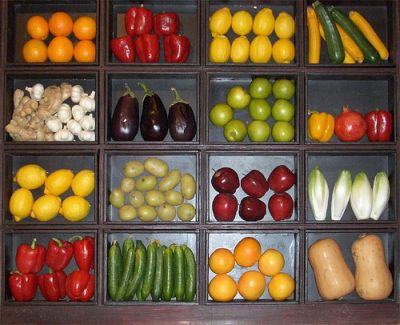
| six oranges | five red peppers |
eight lemons |
four yellow squashes and two zucchini squashes *** lots of squash |
| lots of garlic and ginger ****** lots of garlic cloves ***** a lot of ginger roots |
three eggplants |
nine green apples | one yellow pepper, one pomegranate, and one red pepper |
| six lemons | fifteen potatoes | six
apples half a dozen apples |
four bok choy |
| six red peppers | lots
of green squash |
six golden apples | two butternut squashes |
Photograph of Vegetables, Copyright Carla Saliba.



