Learners of English Are Welcome Here!

Category: Nouns and Pronouns

Navigating the Keyboard in English: Part 3

Beneath the “Function Keys,” which are in orange in the diagram below, you’ll see a (blue) row with a number on the bottom and a symbol on the top. You might recognize these symbols but not know their English names.

What is the correct English word for each of these symbols?
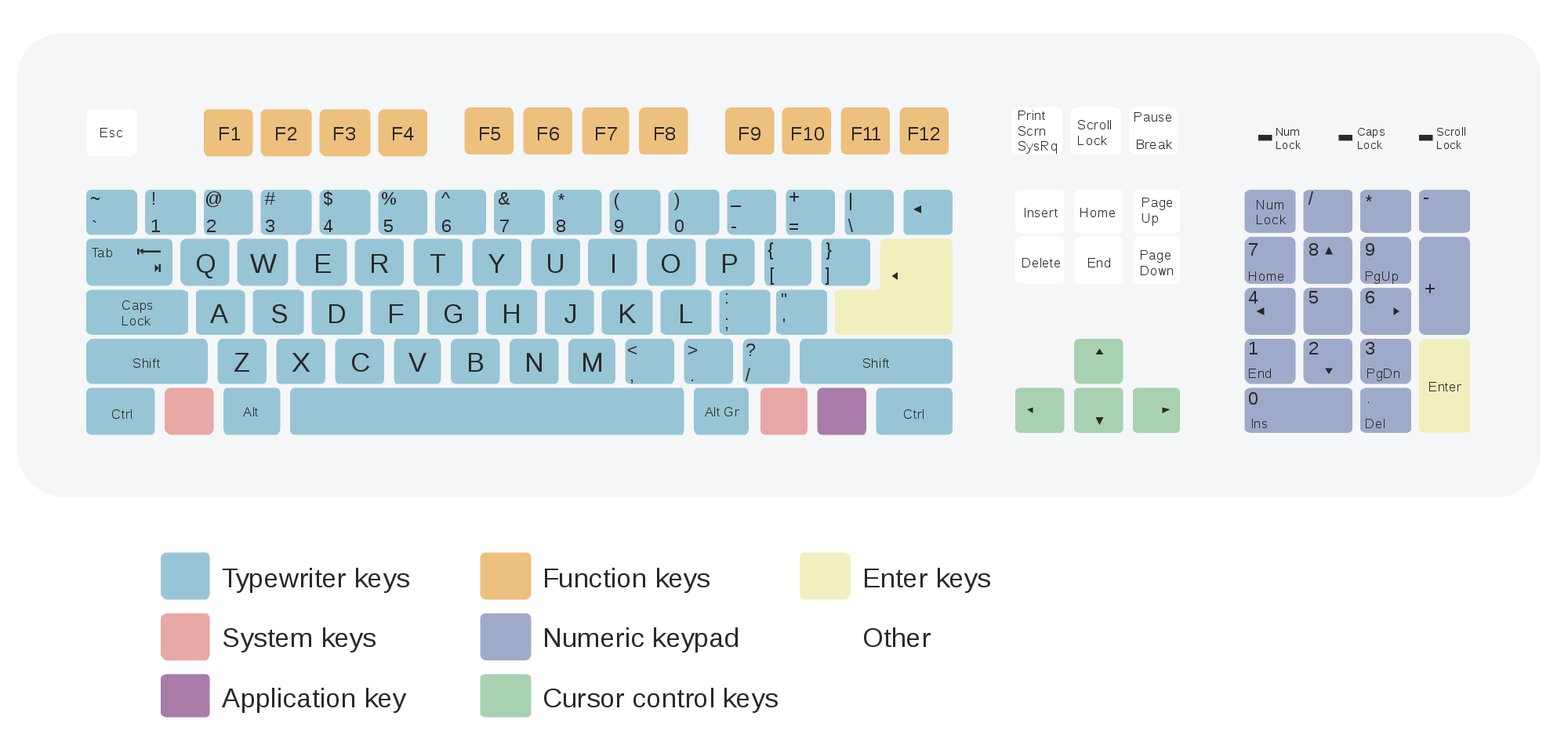
1: Above the numeral ONE (1) is an exclamation mark. ! This is a punctuation mark.

2: Above the numeral TWO (2) is the “at” sign. @ You’ll see this sign in supermarkets: Two lbs (pounds) @ $1.50/each.

3. Above the numeral THREE (3) is the “pound” or the “hash” sign. # You’ll see this sign on telephones.

4. Above the numeral FOUR (4) is the dollar sign. $

5. Above the numeral FIVE (5) is the percent sign. %

6. Above the numeral SIX (6) is the carat. ^ This sign is used in proof-reading.

7. Above the numeral SEVEN (7) is the ampersand. & This commonly means “and.”

8. Above the numeral EIGHT (8) is the asterisk. * This commonly means “and.”

9. Above the numeral NINE (9) is the open parens. (

10. Above the numeral TEN (109) is the close parens. ) Together, the open parens and the close parens are callled “parentheses.” (You might have a comment in parenthesis, like this.)

The last two keys on the top of the numeric line are the underscore _ and the plus sign. The underscore is commonly used in the names of work or computer files: names.on.the.keyboard_English.class.doc.

Of course you know that to type either the underscore key or the plus sign, you must simultaneously* hit the SHIFT key and the symbol key.
*Simultaneously means at the same time.

Now I’ll list this lesson’s vocabulary. See if you can pronounce and point to each one on your keyboard:

  • ( )

Thank you for visiting us for PART #3 of “Navigating the Computer Keyboard in English!

To return to Part 1, click HERE.

Do you have questions? Please write us!
Chapter One. What Is a Noun? Part Two

This lesson is dedicated to anybody who is an immigrant to the USA, to anybody who is the child of an immigrant, and to anybody who is an ancestor of an immigrant, and that probably includes most of us.

Islands, Oceans, and Walls

Nouns and Pronouns: Part Two

Each noun and each pronoun has inflection; this means that it is either singular or plural. This is reflected in the noun or pronoun’s form, which indicates that there is either one (singular) or two or more (plural) of that item.

Nouns   The noun course in the sentence “Then I started building a golf course” is singular, whereas the noun courses in the sentence “Then I started building golf courses” is plural.

Pronouns   The pronouns he, she and it are singular, whereas we and they are plural. The pronoun you can be either singular or plural, depending on its context.

1-1

For Starters 2 Beneath each noun in the sentences below, write N and beneath each pronoun write P. If the noun is singular, write S and if it is plural, write #.
A lot of my friends are gardeners. I never understood it. Then I started
building golf courses—it’s gardening on a big scale.

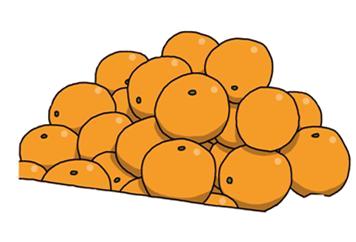
The oranges of the investigation

Countable Nouns

We can categorize nouns into two types: countable and noncountable. A countable noun is a noun that can be counted. Most common nouns are countable. For example, the word hotel is countable because you can count one hotel, two hotels, three hotels, and so on. You can see that countable nouns have a singular form (for example, hotel) and a plural form (for example, hotels).

Use the singular form when you are referring to one of that item. Use the plural form whether you are referring to two units of that item or to billions and billions of units.

1-2

Singular Countable Nouns

In each example below, the noun is countable and the writer is referring to one unit so the noun form must be singular. Notice that each singular countable noun has an article (a, an, the) preceding it in the noun determiner position.

·         This is an island sitting in the middle of an ocean.

·         It’s a big ocean.

·         The wall will happen very soon.

·         I’m not a globalist. I’m a nationalist.

Navigating the Keyboard in English: Part 2

Is it difficult for you to find your way around the computer keyboard in English?

This blog post is Part Two of our look at the English language keyboard used here in the United States. Today we’ll look at the right side of the main cluster of keys. (Click here for Part 1.)

First on the top row we have the backspace key.

The backspace key deletes what you’ve typed, one keystroke at a time.
one stroke at a time
one stroke at a tim
one stroke at a ti
one stroke at a t

and so on.

Next we have the back slash ( \ ) key. You use this key when you are designating file locations on your computer: c:\myeslblog\thekeyboard.doc  or c:\myeslblog\thekeyboard.pdf.

Beneath the backslash key, you have the Enter key. When you use the Enter key alone, it returns you two lines down (i.e. double space).

like this.

and this.

When you use the Enter key and the Shift key at the same time, it returns you one line down.
like this.
or this.

On the bottom row you have the Shift key, again, just like on the right side of the keyboard.  The shift key, again, creates CAPITAL LETTERS or, in terms of the top row of the keyboard, &)&&((#$@%^%&+_), the symbols on the tops of the keys.

Below is a review of the vocabulary used in this blog post:

Now I’ll list our vocabulary:

(to) backspace, the backspace key

backslash      \

(to) enter/to hit the enter key

(to) shift/(to) hit the shift key

(to) return

(to) hit the shift key

So that’s PART TWO of today’s lesson, Navigating the Computer Keyboard in English!

Are you ready for more? Click HERE for PART 3, Navigating the Computer Keyboard in English. Continue reading

© 2009-2026 Software for Students All Rights Reserved -- Copyright notice by Blog Copyright